Tuesday, October 26, 2004
E-mail between officials may break meeting laws
South Dakota's attorney general warns public officials that communicating by e-mail may violate the open meeting law, according to the Rapid City Journal. "My advice to the members of the board about e-mail communication is the same as the communication at lunch," said Attorney General Larry Long. "Don't talk shop over e-mail, or over lunch, or during a basketball game."


Monday, October 25, 2004
Reporting facts from court proceedings privileged
An accurate report of facts from a court proceeding on a matter of public importance may not be the basis of a libel judgement, the Supreme Court of North Dakota ruled last week, according to the Reporters Committee for Freedom of the Press. A state statute provides a privilege for fairly reporting of such facts, the court ruled, dismissing a libel claim brought by Libertarian Party candidate for North Dakota governor, Roland C. Riemers, against the Grand Forks Herald. While Riemers was running for U.S. Senate in 2002, the Herald published a story that cited court findings in Riemers' 2001 divorce that he had beaten his wife and lied about his finances.
Report: Indiana officials routinely violate records law
Public officials in Indiana routinely violate the state's public records law, according to this report produced by eight Indiana newspapers: "Government officials routinely broke or skirted Indiana's open records law during a statewide test by eight newspapers," the report said. It went on:
Journalists presenting themselves as citizens visited government offices in all 92 counties to see how readily officials turned over documents that are supposed to be available to anyone.
While some journalists easily obtained the records, others were intimidated, questioned repeatedly, put off for days, or wrongly told they needed a court order or subpoena. One county worker said it would take 'an act of God' for him to turn over the public document.
The denial of records demonstrates the uphill fight citizens face in obtaining even the most basic government information paid for with their tax dollars.
New rules take effect on access to Maryland court records
New rules governing public access to Maryland court records took effect Oct. 1, The Montgomery County Sentinel reports. The Access to Court Records Rules, contained in Title 16 chapter 1000 of the Maryland Rules of Procedure, makes internal administrative records subject to the Maryland Public Information Act, although administrative records connected with judicial work in progress such as drafts of decisions and opinions or memoranda are not accessible. Administrative records pertaining to jury selection are closed until the jury has been sworn in. Case records are presumed open to the public except if closed by an existing statute or rule, or by a court order.
Wednesday, October 20, 2004
Macro and micro views on the First Amendment
The First Amendment Center has two articles that together offer perspective on the broad and narrow protections afforded by the First Amendment. One, Wartime Riskiest for Free Speech, Scholar Says, is an interview with University of Chicago Law School Professor Geoffrey R. Stone, author of the soon-to-be-released book, Perilous Times: Free Speech in Wartime. "The United States government has never attempted directly to suppress criticism of public policies or public officials except in time of war," Stone says. The other, Unlikely Hero Emerges in Struggle for Courtroom Access, tells the story of Scott Huminski, a critic of the Vermont courts who recently won a ruling from the 2nd U.S. Circuit Court of Appeals that the First Amendment prevents Vermont court officials from barring him from their proceedings.
Tuesday, October 19, 2004
Court upholds jail sentence for open-meeting violation
A former Florida Senate president's conviction and 60-day jail sentence for violating the state's Sunshine Law as a county commissioner has been upheld by a three-judge panel of Florida's 1st District Court of Appeal, according to this report. W.D. Childers, convicted by a jury in 2002 after he discussed public business in private with a fellow Escambia County commissioner, has already served 38 days of his sentence.
Thursday, October 07, 2004
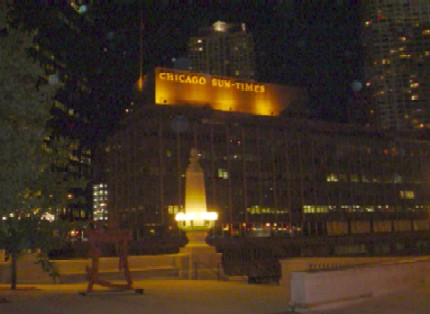
For Chicago newspaper, the end of an era
Odd. I was in Chicago this week and felt the impulse to run into my hotel room, grab my camera, run back out into the street and snap this photo of the Chicago Sun-Times building, having no idea I was memorializing the end of an era in newspaper history.
Publishers lose lawsuit over Back Bay newsracks
Three newspaper publishers lost their federal court challenge to a local ordinance prohibiting the use of newsracks in Boston's Back Bay. U.S. District Judge Douglas P. Woodlock ruled Aug. 27 that the ordinance does not violate the publishers' First Amendment rights because the ordinance allows "reasonable alternative means of distribution."
"While the guideline forces plaintiffs to use distribution means in the district which they find economically unappealing or that they would otherwise not use," Woodlock said, "this does not change the fact that alternatives to newsracks in the district are available to plaintiffs."
The three newspapers – Editorial Humor, Boston's Weekly Dig and The Improper Bostonian – filed the lawsuit in 2001 after Boston's Back Bay Architectural Commission adopted a guideline prohibiting "street furniture" from the Back Bay Architectural District.
The newspapers contended that the commission violated their First Amendment rights by imposing a flat ban on all newsracks, rather than tailoring the ban more narrowly in a way that would still preserve the aesthetics of the neighborhood. They also argued that the ordinance violated their free speech rights by not providing an economically feasible alternative means of distribution within the Back Bay.
Relying on a 1996 decision by the 1st U.S. Circuit Court of Appeals in a challenge to a similar ban on newsracks in Boston's Beacon Hill, Woodlock ruled against the publishers on all counts. The legal standard, Woodlock said, is that the ordinance would be acceptable if it was "narrowly tailored to serve a significant governmental interest" and would "allow for reasonable alternative channels of communication."
The publishers argued that the commission could have narrowed the ordinance and still achieved its aesthetic goals through a regulation that provided for approval of newsracks on a case-by-case basis. But Woodlock found that the commission acted appropriately in considering the alternatives and adopting "what it perceived to be the most effective solution to the perceived problem with newsracks."
Woodlock likewise rejected the publishers' arguments that the ordinance left them with no reasonable alternatives for distributing their newspapers because other options – street vendors, store placement, mail and home delivery – were prohibitively expensive. He said that the publishers offered no evidence to prove this argument. "Plaintiffs have failed to adduce any meaningful evidence of the cost of using street vendors in the district, much less show how such cost compares to the cost of installing and maintaining newsracks there."
The decision is HOP Publications v. City of Boston, U.S. District Court civil action number 01-11536-DPW.
"While the guideline forces plaintiffs to use distribution means in the district which they find economically unappealing or that they would otherwise not use," Woodlock said, "this does not change the fact that alternatives to newsracks in the district are available to plaintiffs."
The three newspapers – Editorial Humor, Boston's Weekly Dig and The Improper Bostonian – filed the lawsuit in 2001 after Boston's Back Bay Architectural Commission adopted a guideline prohibiting "street furniture" from the Back Bay Architectural District.
The newspapers contended that the commission violated their First Amendment rights by imposing a flat ban on all newsracks, rather than tailoring the ban more narrowly in a way that would still preserve the aesthetics of the neighborhood. They also argued that the ordinance violated their free speech rights by not providing an economically feasible alternative means of distribution within the Back Bay.
Relying on a 1996 decision by the 1st U.S. Circuit Court of Appeals in a challenge to a similar ban on newsracks in Boston's Beacon Hill, Woodlock ruled against the publishers on all counts. The legal standard, Woodlock said, is that the ordinance would be acceptable if it was "narrowly tailored to serve a significant governmental interest" and would "allow for reasonable alternative channels of communication."
The publishers argued that the commission could have narrowed the ordinance and still achieved its aesthetic goals through a regulation that provided for approval of newsracks on a case-by-case basis. But Woodlock found that the commission acted appropriately in considering the alternatives and adopting "what it perceived to be the most effective solution to the perceived problem with newsracks."
Woodlock likewise rejected the publishers' arguments that the ordinance left them with no reasonable alternatives for distributing their newspapers because other options – street vendors, store placement, mail and home delivery – were prohibitively expensive. He said that the publishers offered no evidence to prove this argument. "Plaintiffs have failed to adduce any meaningful evidence of the cost of using street vendors in the district, much less show how such cost compares to the cost of installing and maintaining newsracks there."
The decision is HOP Publications v. City of Boston, U.S. District Court civil action number 01-11536-DPW.
Thursday, September 30, 2004
Regional school committee violated open meeting law
When the Groton Dunstable Regional School Committee went into executive session to choose names for its new middle schools, it violated the Massachusetts Open Meeting Law, the Boston Globe reports in an article by correspondent Susan Ware. Concerned that debate about naming a school after environmental activist Marion Stoddart might prove embarrassing to Stoddart, the School Committee decided to discuss the matter in a closed session. But the Open Meeting Law, Ware writes:
"clearly defines topics that can be discussed in executive sessions, such as official misconduct, contract negotiations, and land purchases. The naming of public buildings does not fall within the guidelines. When the committee checked with District Attorney Martha Coakley's office, it was informed of the error, according to School Committee chairman Alan Vervaeke."Vervaeke, the Globe reported, said the district attorney's office told him there would be no penalties for the error.
Wednesday, September 15, 2004
U.S. concedes error in forcing erasure of Scalia's speech
From the Associated Press, via Law.com:
"The government has conceded that the U.S. Marshals Service violated federal law when a marshal ordered reporters with The Associated Press and the Hattiesburg American to erase their recordings of a speech by Supreme Court Justice Antonin Scalia.
"The Justice Department also said the reporters and their employers are each entitled to $1,000 in damages and reasonable attorney fees, which had been sought by the media organizations."
Friday, September 03, 2004
Confidentiality is 'essential,' news media tell judge
From AP, via firstamendmentcenter.org:
"WASHINGTON — Journalists need protection from having to reveal confidential sources if they are to keep the public informed, news organizations argued in a newly unsealed court filing.
"U.S. District Judge Thomas F. Hogan agreed to the release of the papers, filed last week in the case of reporters from The New York Times and The Washington Post, who have been called to testify before a grand jury investigating the leak of the identity of a covert CIA officer.
"Hogan has already rejected claims that the First Amendment protects journalists and other organizations from having to testify as part of the investigation into who in the Bush administration leaked the identity of CIA officer Valerie Plame."
Tuesday, August 31, 2004
School committee skirts open meeting law
The Fitchburg, Mass., Sentinel & Enterprise reports on the Fitchburg School Committee's skirting of the open meetings law:
"Executive session minutes released by the Fitchburg School Committee Monday are 'vague' and violate the spirit of open meeting laws, according to two experts in First Amendment law.
"School Committee members voted to approve and release executive session minutes from meetings starting in January through July at Monday night's meeting, after the Sentinel & Enterprise requested the records.
"But the documents released provide only one or two sentence summaries of the general nature of the meetings, rather than a full account of what was said."
Lucy Dalglish: New attacks on the First Amendment
Lucy Dalglish, a lawyer, journalist and executive director of The Reporters Committee for Freedom of the Press, on journalists' tough summer:
"First Amendment principles that generally had been considered settled since the days of Watergate and the Pentagon Papers are under attack. It has been at least 30 years since we have seen such a dramatic weakening of fundamental protections for gathering and publishing of news."
Subscribe to:
Posts (Atom)