Tuesday, May 10, 2005
Texas shield law attempt dies in Senate
A proposed Texas shield law for journalists fizzled yesterday in the state Senate, AP reports. The sponsor backed off the measure after it ran into hostility from other lawmakers opposed to special protections for reporters and their sources. Texas newspapers and broadcasters had joined forces to push for the bill.


Wednesday, May 04, 2005
U.S. courts publish journalist's guide
The Administrative Office of the U.S. Courts published a new resource on its Web site Monday created to assist news reporters assigned to cover court proceedings. A Journalist's Guide to the Federal Courts contains chapters on U.S. district, bankruptcy and appellate courts. It provides an overview of the judicial process and key players, and discusses types and sources of court information.
Attorney who leaked tape to Taricani charged with contempt
From AP via law.com: "A defense attorney was charged Monday in Providence, R.I., with leaking an FBI surveillance video to a TV reporter, who nearly went to prison for refusing to identify his source."
Tuesday, May 03, 2005
Public records case scheduled for SJC arguments today
As I noted Sunday on my LawSites blog, the Supreme Judicial Court of Massachusetts yesterday officially launched webcasts of oral arguments. I note from the court's docket today that it is scheduled to hear arguments in Harvard Crimson Inc. v. President & Fellows of Harvard College, dealing with the question of whether incident reports of the Harvard University Policy Department are subject to the Public Records Act. So tune in and watch.
Friday, April 29, 2005
Federal shield bill heads for hearings
The House Judiciary Committee is holding a hearing May 12 on a bill that would create a federal shield law, AP reports. The bill would prohibit federal judges from forcing journalists to reveal their confidential sources.
Bloggers should have same legal rights as mainstream media, survey says
Most Americans believe bloggers should enjoy the same Constitutional protection as traditional journalists, but a majority said they still prefer to get their information from the mainstream media, according to a recent survey reported at InternetNews.com.
Fifty-two percent of those surveyed in a poll conducted by Web hosting company Hostway said bloggers should have the same protection under the First Amendment of the Bill of Rights as the mainstream media, while 27 percent expressed no opinion on the subject.
But the survey suggests that bloggers are not taken as seriously as the traditional media. Thirty-nine percent said they found blogs less credible than newspaper articles, and 38 percent said blogs were less credible than television news. Nearly one-fourth found magazine advertising to be more credible.
Thursday, April 14, 2005
Maine paper seeks release of brain-donation records
The Portland Press Herald has filed a lawsuit under Maine's Freedom of Access Act seeking state medical examiner forms that identify deceased brain donors and their next-of-kin, but the Maine attorney general is fighting their release, saying they reveal private information, the newspaper reports.
Rhode Island AG sues town for 'willful' violations of public records law
Rhode Island Attorney General Patrick Lynch has filed suit against the Town of Barrington for "willfully and knowingly" violating the state's Access to Public Records Act and Open Meetings Act, the Barrington Times reports. The suit claims the town violated open government laws approximately 200 times.
An ominous climate for freedom of the press
So says Nicholas D. Kristof writing for the op-ed page of The New York Times. A major reason, he says in this thoughtful piece, is that the "media are widely perceived as arrogant, out of touch and untrustworthy." He concludes:
"If one word can capture the public attitude toward American journalists, I'm afraid it's 'arrogant.' Not surprisingly, I think that charge is grossly unfair. But it's imperative that we respond to that charge - not by dismissing it, but by working far more diligently to reconnect with the public.
"Unless we can recover the public trust, our protests about reporters' going to jail will come across as self-serving whining. And we'll wake up one day to find ourselves on the wrong side of history."
Wednesday, April 06, 2005
Federal judge imposes gag order on reporter
A federal judge in Massachusetts last week imposed a gag order against The Standard-Times in New Bedford, barring it from publishing what reporter Ray Henry heard on March 31 at a court hearing on a motion by an accused drug trafficker.
The gag order expired this morning when federal prosecutors failed to file an appeal.
During the March 31 hearing before U.S. District Judge Robert E. Keeton, federal prosecutors disclosed what the court determined was privileged information without first determining who was in the courtroom. The session was not closed to the public and the reporter and others were permitted by a U.S. marshal to enter.
The gag order was set to expire at 11 a.m. today, unless prosecutors or defense lawyers asked the Court of Appeals to intervene. The newspaper called the gag order prior restraint of its First Amendment rights.
See the Standard-Times report: S-T challenges gag order in drug case.
Monday, March 21, 2005
Teen loses defamation suit against Boston Magazine
A teenager whose photograph appeared in a Boston Magazine story entitled "The Mating Habits of the Suburban High School Teenager" has lost her defamation suit against the magazine, according to Media Law Prof Blog.
Round-up of Sunshine Week coverage in Mass. papers
With Sunshine Week now over, I offer my round-up of coverage from Massachusetts newspapers. Most certainly, this is incomplete, compiled primarily from what I found online and what others pointed out to me. If you know of other pieces, please let me know.
Particularly impressive was the coverage by the Metrowest Daily News, with multiple reports every day of the week.
March 13
Particularly impressive was the coverage by the Metrowest Daily News, with multiple reports every day of the week.
March 13
- Metrowest Daily News: Publishers Propose Legislation
- Metrowest Daily News: It's not too hard to get the scoop on neighbors
- Metrowest Daily News: What have they got to hide?
- Metrowest Daily News: Rules shed light on government
- Metrowest Daily News: Seeking out the truth
- Metrowest Daily News: Open meeting law sanctions
- Metrowest Daily News: Spitz: Shopping a trial
- Metrowest Daily News: Editorial: Let sunshine cleanse our governments
- Metrowest Daily News: Lodge: Let the sun shine in
- The Republican: Larry McDermott: Focusing on the Public's Right to Know
- Worcester Telegram: Making Government More 'Open': Bills Promote the Public's Right to Know
- Worcester Telegram: Sunshine Governance
- Worcester Telegram: Poll: Seven out of 10 Americans Worry About Government Secrecy
- Worcester Telegram: T&G Appeals Blackout of Information in Complaints
- Sun Chronicle: Editorial: Let Sun Shine on Government
- Eagle Tribune: Bill Ketter: The Press, the Public and the Challenges to Open Government
- Cape Cod Times: Review Sees Government Tightening Information Loop
- Cape Cod Times: Privacy Act Creates Confusion
- Metrowest Daily News: Information valuable to a suburban homebuyer
- Metrowest Daily News: Local governments sometimes go out of their way to avoid explaining decisions
- Metrowest Daily News: Dwinell: Schools learn about public records law
- Fitchburg Sentinel: Let the sun shine in
- Milford Daily News: Challenges to local meetings have yielded few violations, say DAs
- Metrowest Daily News: Clerks speak up on your right to records
- Metrowest Daily News: Federal government releasing less information since '98
- Metrowest Daily News: Find out where your town's sex offenders live
- Metrowest Daily News: Open Meeting does not apply to lawmakers
- Metrowest Daily News: From the FOIA files
- Metrowest Daily News: Keeping Track of FOIA requests
- Metrowest Daily News: Celebrating our freedoms
- Cambridge Chronicle: Sun shines on public records
- Somerville Journal: Public records laws get use by activists in Somerville
- Needham Times: Public records available to everyone
- Wayland Town Crier: Clerks promote right to records
- Wellesley Townsman: Editorial: Consistency in access to records
- Wellesley Townsman: Getting meeting minutes can take time
- Beverly Citizen: Editorial: Sunny side up
- West Roxbury & Roslindale Transcript: Publishers propose legislation
- West Roxbury & Roslindale Transcript: Law keeps meetings open for all
- The Beacon: E-mail is a boon and a crutch
- Metrowest Daily News: Public records laws a mixed bag in R.I.
- Metrowest Daily News: Survey yields consistent results: Little difficulty found in retrieving arrest logs
- Daily News Transcript: Access to project data unimpaired
- Shirley Oracle: National Sunshine Week: Shedding light on the public's right to know
- The Cape Codder: In the public view
- The Republican: Six bills seek overhaul of state law
Friday, March 18, 2005
Bills seek overhaul of state law
The Springfield Republican today reported on the bills filed by the Massachusetts Newspaper Publishers Association to toughen the enforcement provisions of the state's open meetings laws. I am among the sources interviewed for the story, which was written by reporters Dan Ring and Buffy Spencer.
Here is an excerpt:
Here is an excerpt:
"State and municipal officials would face fines if they intentionally violate the state's Open Meeting Law, according to legislation pending on Beacon Hill.Read more.
"Opponents said the legislation would discourage people from serving in government and would clog the courts with more lawsuits. Supporters said the bills are needed to toughen enforcement of the law.
"Six bills to overhaul the law were filed by Rep. Arthur J. Broadhurst, D-Methuen, at the request of the Massachusetts Newspaper Publishers Association."
New England newspaper group announces First Amendment awards
I attended the annual meeting today of the New England Newspaper Association, where NENA announced the winners of the first Morley L. Piper First Amendment Award, named for NENA's longtime executive director. The winners were The Republican of Springfield and The Providence Journal. NENA's awards committee decided last year to establish the annual award to highlight the work that newspapers do in educating and upholding the First Amendment.
For more on the awards, read this AP report.
For more on the awards, read this AP report.
Friday, March 11, 2005
Blogshine Sunday: support access to government information
 This Sunday, news organizations across America will participate in Sunshine Sunday -- kick off to Sunshine Week -- by running stories supporting access to government information. Not wanting bloggers to be excluded, FreeCulture.org is organizing Blogshine Sunday, to encourgage bloggers across the U.S. and beyond to write about the need for open government in the digital age.
You can join Blogshine Sunday by writing in your blog about open government and how it relates to you. The Blogshine Sunday blog will aggregate and link to the postings. (Go to the site for instructions on how to link your posting.)
Wednesday, March 09, 2005
Cape Cod Times wins access to sheriff's records
The Supreme Judicial Court yesterday ruled that Barnstable County Sheriff James Cummings must provide to the Cape Cod Times the identities of his reserve deputy sheriffs, whose names he has concealed for two years.
The SJC said that the names are public records under G.L. c. 66, s. 10, and must be made available for examination and inspection.
The sheriff had contended that the records were private because the reserve deputies have no law enforcement duties and also that the records belonged to the private Barnstable County Sheriffs Association.
- Cape Cod Times report: Sheriff Must Give Times Names of Reserves.
- Another: Ruling Seen as Key to Public Access.
- AP: Cape Cod Times Scores Ruling in Sheriff's Records Case
- Here is the SJC's decision: Cape Cod Times v. Sheriff of Barnstable County.
Friday, March 04, 2005
Judge says bloggers can be forced to reveal sources
In a case with implications for the freedom to blog, a San Jose judge tentatively ruled yesterday that Apple Computer can force three online publishers to surrender the names of confidential sources who disclosed information about the company's upcoming products, reports The Mercury News.
Santa Clara County Superior Court Judge James Kleinberg refused to extend to the Web sites protection either under California's shield law or under the First Amendment.
Kleinberg offered no explanation for the preliminary ruling. He will hear arguments today from Apple's attorneys and the Electronic Frontier Foundation, a San Francisco digital rights group representing two of the three Web sites Apple subpoenaed -- Apple Insider and PowerPage.
EFF has more information about the case here.
Thursday, February 24, 2005
Shield laws offer illusory protection, columnist says
Writing in the Chicago Tribune, public editor Don Wycliff says he is opposed to a federal shield law:
"You see, if the government gives journalists the right to be exempt from the normal obligations of citizenship, the government, ultimately, will get to decide who is a journalist. Of course nobody will admit that this is the case. They'll contrive some body of journalistic wise men and women, a college of cardinals, who will set standards and thresholds and regulations and such. But somebody will have to appoint those cardinals and, in the end, it will be the government that's in charge."
Judge: First Amendment protects newspaper's source
In Manhattan today, U.S. District Judge Robert W. Sweet ruled that the New York Times has a First Amendment right to protect the confidentiality of its sources by denying the government phone records in certain instances, AP reports.
Saying that secrecy in government appears to be on the increase, Sweet refused to dismiss a lawsuit the newspaper filed last year to stop the Department of Justice from getting records of phone calls between two veteran journalists and sources, according to AP. The calls between journalists Judith Miller and Philip Shenon and their sources were made in the aftermath of the Sept. 11 attacks.
Saying that secrecy in government appears to be on the increase, Sweet refused to dismiss a lawsuit the newspaper filed last year to stop the Department of Justice from getting records of phone calls between two veteran journalists and sources, according to AP. The calls between journalists Judith Miller and Philip Shenon and their sources were made in the aftermath of the Sept. 11 attacks.
Friday, February 18, 2005
Jury finds Boston Herald libeled judge
The Boston Herald was ordered today to pay $2.1 million for libeling a Superior Court judge in articles that portrayed him as lenient toward defendants and quoted him making insensitive comments about a 14-year-old rape victim, AP reports.
In a case closely watched by the media and legal communities, a jury deliberated for more than 20 hours over five days before finding that the newspaper and reporter David Wedge had libeled Superior Court Judge Ernest B. Murphy. Another reporter was cleared.
In a case closely watched by the media and legal communities, a jury deliberated for more than 20 hours over five days before finding that the newspaper and reporter David Wedge had libeled Superior Court Judge Ernest B. Murphy. Another reporter was cleared.
Thursday, February 17, 2005
ASNE counsel concurs on OPEN Government Act
In response to my post yesterday, OPEN Government Act appears to protect bloggers as members of media, I received the following note from Kevin M. Goldberg, a partner with Cohn and Marks LLP and counsel to the American Society of Newspaper Editors:
"Although I cannot speak for the intent of Senator Cornyn as to the meaning of this section, the addition of the final sentence in that section would appear to cover bloggers as it directly speaks to new journalists without much prior publication history. It may be instructive to note that the final sentence was not in the first draft of the bill because this language does what the first two sentences do not -- it creates a 'functional' definition of a member of the news media, looking beyond the requestor's affiliation or publication history to his or her intent to disseminate news or information at the time of the request. It also avoids content review by the government's FOIA officers. These seem to level the playing field for freelancers who are worthy of this fee waiver (and I for one, would classify bloggers as a subcategory of 'freelancers' in many ways)."
Wednesday, February 16, 2005
OPEN Government Act appears to protect bloggers as members of media
The bipartisan OPEN Government Act filed today by U.S. senators John Cornyn (R-Texas) and Patrick Leahy (D-Vermont) would appear to protect bloggers from excessive fees under the federal Freedom of Information Act.
Present law provides that for representatives of the news media, "fees shall be limited to reasonable standard charges for document duplication."
The bill filed today expands the definition of news media as follows:
A reasonable reading of this language would be that it would apply to bloggers, since they can demonstrate a history of publishing and of distribution to a reasonably broad audience.
The bill, S. 394, is aimed at substantially enhancing and expanding the accessibility, accountability and openness of the federal government. Its full name is the Openness Promotes Effectiveness in our National Government Act of 2005.
Among the groups supporting it are the Reporters Committee for Freedom of the Press and the ACLU.
Present law provides that for representatives of the news media, "fees shall be limited to reasonable standard charges for document duplication."
The bill filed today expands the definition of news media as follows:
"In making a determination of a representative of the news media ..., an agency may not deny that status solely on the basis of the absence of institutional associations of the requester, but shall consider the prior publication history of the requester. Prior publication history shall include books, magazine and newspaper articles, newsletters, television and radio broadcasts, and Internet publications. If the requestor has no prior publication history or current affiliation, the agency shall consider the requester's stated intent at the time the request is made to distribute information to a reasonably broad audience."Under this language, one would need not be affiliated with an "institutional" news outlet to be considered a member of the news media, particularly if the person could show a history of publishing, including publishing on the Internet. Even in the absence of a publishing history, one could be considered a member of the news media if the information were sought with the intent of distributing it "to a reasonably broad audience."
A reasonable reading of this language would be that it would apply to bloggers, since they can demonstrate a history of publishing and of distribution to a reasonably broad audience.
The bill, S. 394, is aimed at substantially enhancing and expanding the accessibility, accountability and openness of the federal government. Its full name is the Openness Promotes Effectiveness in our National Government Act of 2005.
Among the groups supporting it are the Reporters Committee for Freedom of the Press and the ACLU.
Web site aims to foster freedom of information
 A new Web site has been launched as a companion to the first Sunshine Week, a March 13-19 national event aimed at promoting awareness of the importance of open government and freedom of information laws. Sunshine Week is spearheaded by the American Society of Newspaper Editors and supported by the Newspaper Association of America, The Associated Press and other media companies, newspapers, magazines, academia and journalism organizations.
The site serves as a central clearinghouse for participants, with links to background reports, open-government organizations, and other material available for publication such as op-ed columns.
Tuesday, February 15, 2005
Reporters Committee calls for shield law
The Reporters Committee for Freedom of the Press today issued a statement calling for a coordinated effort to support a federal shield law in the wake of the decision by the U.S. Court of Appeals in the District of Columbia Circuit today that two prominent journalists do not have a privilege to keep sources of information from a federal grand jury.
"The decision in this case underscores that these are perilous times for journalists and the public's right to know," said Reporters Committee Executive Director Lucy Dalglish. "There are more than two dozen cases pending across the United States where journalists are being asked to operate as investigators for the government and litigants. The ability of the media to act as independent sources of information for the public is in jeopardy."
The shield bills current under consideration in Congress were introduced in early February by Reps. Mike Pence (R-Ind.) and Rick Boucher (D-Va.) in the House (H.R. 581), and by Sen. Richard Lugar (R-Ind.) in the Senate (S. 3440). A similar bill was introduced late in the last congress by Sen. Chris Dodd (D-Conn.), but no action was taken.
Judge dismisses Baltimore Sun suit against governor's ban
A federal judge ruled yesterday that Maryland Gov. Robert Ehrlich can freeze out two reporters from The Baltimore Sun by barring all state employees from talking to the journalists, AP reports.
U.S. District Judge William Quarles dismissed the newspaper's lawsuit, saying the paper wrongly asserted a greater right to access to government officials than private citizens have.
"The right to publish news is expansive. However, the right does not carry with it the unrestrained right to gather information," the judge ruled.
Sun editor Tim Franklin called the ruling "scary" and said the newspaper would seek an expedited hearing from the 4th Circuit Court of Appeals.
Appeals court says reporters must testify or go to jail
Two reporters who have refused to name their sources to a grand jury investigating the disclosure of the identity of a covert C.I.A. agent should be jailed for contempt, a three-judge panel of the federal appeals court in Washington unanimously ruled today, The New York Times reports.
Citing a 1972 decision of the United States Supreme Court, the panel held that the reporters, Judith Miller of The New York Times and Matthew Cooper of Time magazine, have no First Amendment protection from grand jury subpoenas seeking the names of their sources. It can be a crime for government officials to divulge the identities of covert agents.
For the full text of the court's opinion, go here.
Thursday, February 10, 2005
Bankruptcy judge orders release of company report
A federal bankruptcy judge in Massachusetts yesterday reversed an earlier decision and ruled that an examiner's report on the Gitto/Global Corporation should be released, the Sentinel & Enterprise reports.
Judge Joel B. Rosenthal had ruled on Jan. 5 that a court-appointed examiner's report on the Lunenburg, Mass., company, which filed for Chapter 11 bankruptcy in September 2003, should be sealed.
The reversal means the full report will be made available to the public on Feb. 23. The Sentinel & Enterprise had filed a motion with the court seeking the release of the report.
Rehnquist as 'Deep Throat'?
Editor & Publisher magazine polled its readers to guess the identity of Watergate legend Deep Throat. The surprise winner: Chief Justice William Rehnquist.
In affirming libel award, SJC strikes blow to protection of confidential sources
The Supreme Judicial Court yesterday issued its decision in Ayash v. Dana-Farber Cancer Institute, and the outcome was a blow to the news media. The SJC upheld the trial judge's entry of default judgment against the Boston Globe because of the Globe's refusal to reveal the identities of confidential sources. Based on that default judgment, a jury awarded damages against the Globe of $2.1 million -- $300,000 for economic damages and $1.8 million for emotional distress – which the SJC also upheld.
The lawsuit followed from the discovery that two patients in an experimental breast cancer treatment study at Dana-Farber had mistakenly been given an overdose of a toxic chemotherapy drug. One of the patients, Globe health columnist Betsy A. Lehman, died. The plaintiff, Dr. Lois J. Ayash, an investigator in the study, sued Dana-Farmer, Dr. David M. Livingston, the Boston Globe and Globe reporter Richard A. Knox. She accused the Globe of libel and defamation, and sued Knox for intentional interference with contractual relations and for intentional or negligent infliction of emotional distress.
During discovery, Ayash sought to compel the Globe to reveal the identities of its sources. Concluding that the sources' identities were central to the plaintiff's claims, the judge ordered their disclosure. When the Globe continued to protect their identities, the judge imposed a series of escalating fines. After an interim appeal and remand, Ayash again sought to compel the Globe to disclose its sources. When the Globe continued to refuse, Ayash asked for sanctions. As a sanction, the judge ordered that judgments of liability enter in favor of Ayash against the Globe and Knox. Because his earlier monetary sanctions had not succeeded in securing the Globe's compliance, the judge reasoned, the alternative sanction of default judgment was warranted. With liability determined by default, the case was submitted to a jury for assessment of damages. The jury came back with an award against the Globe of $2.1 million.
On appeal, the SJC concluded that the judge had not abused his discretion in entering the default judgment.
"At the time of the judge's ruling, the overdose incidents had occurred over six years previously. There is nothing in the record to suggest that Knox continued to receive or collect information pertaining to the overdoses from these sources that would justify the continued concealment of their identities. The judge concluded that their identities, and information that they potentially could reveal, bore directly on the plaintiff's claims against Knox and Dana-Farber. …Having affirmed the entry of default judgment against the Globe, the SJC turned to the jury's award of damages.
"Over a period of years, the judge had ordered the Globe defendants to comply with the plaintiff's requests for discovery of this information, to no avail. The Globe defendants made a deliberate choice to protect Knox's sources and to forgo their (potentially meritorious) defenses to the claims asserted against them rather than obey the judge's orders. The judge was not trying to punish the Globe defendants. He clearly felt that he had no alternative method of enabling the plaintiff to obtain the information she needed, and he left open to the Globe the option to remove the default by complying. The question for our review is whether the judge's order constituted an abuse of the "broad measure of discretion" afforded him. See Sinnott v. Boston Retirement Bd., 402 Mass. 581, 585, cert. denied, 488 U.S. 980 (1988). We conclude that it did not."
"A plaintiff in a successful defamation case is entitled only to fair compensation for actual damages, including emotional distress and harm to reputation (and any special damages which have been pleaded and proved). ... Although the damages awarded the plaintiff for the defaulted claims against the Globe defendants may appear high, they were based on evidence that the Globe articles impugning the plaintiff affected her career and caused her a great deal of emotional and psychological anguish. … The judge found no basis on which to overturn the awards as excessive, and neither do we."[Note: The Massachusetts Newspaper Publishers Association, of which I am executive director, participated in this case as amicus.]
Tuesday, February 08, 2005
Not all grand jury information is confidential under FOI Act
Partial calendar information relating to the Justice Department's participation in a grand jury investigation that does not reveal juror or witness names must be released under the Freedom of Information Act, the U.S. Court of Appeals in Washington, D.C., has ruled.
A convicted drug dealer representing himself in court won the right to see the dates on which federal prosecutors interviewed potential witnesses in a grand jury investigation of alleged money laundering by his lawyer.
In Lopez v. Department of Justice, decided Jan. 11, Circuit Judge David B. Sentelle, writing for a unanimous three-judge panel, ruled that grand jury confidentiality was not meant to draw an impenetrable "veil of secrecy" around all grand jury-related information, only such information as would "tend to reveal some secret aspect of the grand jury's investigation."
Iowa university foundations' records open, court says
The Iowa Supreme Court has ruled that the fund-raising arms of Ohio's three universities must open their records to the public, Associated Press reports.
The court ruled in Gannon v. Board of Regents that the Iowa State University Foundation "is performing a government function, and therefore its records are subject to disclosure."
The court ruled in Gannon v. Board of Regents that the Iowa State University Foundation "is performing a government function, and therefore its records are subject to disclosure."
HIPAA restricts public access to records
Designed to give people privacy in an electronic age, the Health Insurance Portability and Accountability Act of 1996, known as HIPAA, has lessened the public's access to public records across the nation, according to this Associated Press report.
"Police departments have cited it as a reason to withhold information. Nursing homes have cited it as a reason not to inform residents about registered sex offenders living in their midst. And health departments have cited it for not reporting diseases.
"As interpreted in 2003 by the U.S. Department of Health and Human Services, which that year developed privacy rules, it has prevented the release of public records across the nation, said Lucy Dalglish, executive director of the Reporters Committee for the Freedom of the Press."
Monday, February 07, 2005
Reporter's shield bill introduced in House
A bill to provide reporters with an absolute privilege against compelled disclosure of their sources was introduced in the House last week by Reps. Mike Pence (R-Ind.) and Rick Boucher (D-Va.).
The Free Flow of Information Act (H.R. 581) would keep journalists from being subpoenaed to testify or reveal any other information unless all other sources for the information had been exhausted and the material was essential to the underlying court case or investigation.
"Reporters rely on the ability to assure confidentiality to sources in order to deliver news to the public, and the ability of news reporters to assure confidentiality to sources is fundamental to their ability to deliver news on highly contentious matters of broad public interest," Boucher said in a press release. "Without the promise of confidentiality, many sources would not provide information to reporters and the public would suffer from the resulting lack of information."
Sen. Chris Dodd (D-Conn.) introduced a similar bill in the Senate last year, and is expected to reintroduce it in this session.
The bill provides that the federal government may not compel a "covered person" to testify or produce any document in any proceeding or in connection with any issue arising under federal law unless a court determines by clear and convincing evidence that the entity has unsuccessfully attempted to obtain the testimony or document "from all persons from which such testimony or document could reasonably be obtained."
In criminal cases, the government also must show that it has reasonable grounds to believe a crime has occurred and that the testimony or document is essential to the investigation, prosecution or defense.
In non-criminal matters, the government must show that the testimony or document is essential to a dispositive issue of substantial importance.
The law would prohibit the federal government from compelling a reporter to disclose the identify of a confidential source or of any information that could be expected to lead to the identity of a confidential source.
The bill defines "covered person" as "an entity that disseminates information by print, broadcast, cable, satellite, mechanical, photographic, electronic or other means." The entity must also do one of the following:
More information:
The Free Flow of Information Act (H.R. 581) would keep journalists from being subpoenaed to testify or reveal any other information unless all other sources for the information had been exhausted and the material was essential to the underlying court case or investigation.
"Reporters rely on the ability to assure confidentiality to sources in order to deliver news to the public, and the ability of news reporters to assure confidentiality to sources is fundamental to their ability to deliver news on highly contentious matters of broad public interest," Boucher said in a press release. "Without the promise of confidentiality, many sources would not provide information to reporters and the public would suffer from the resulting lack of information."
Sen. Chris Dodd (D-Conn.) introduced a similar bill in the Senate last year, and is expected to reintroduce it in this session.
The bill provides that the federal government may not compel a "covered person" to testify or produce any document in any proceeding or in connection with any issue arising under federal law unless a court determines by clear and convincing evidence that the entity has unsuccessfully attempted to obtain the testimony or document "from all persons from which such testimony or document could reasonably be obtained."
In criminal cases, the government also must show that it has reasonable grounds to believe a crime has occurred and that the testimony or document is essential to the investigation, prosecution or defense.
In non-criminal matters, the government must show that the testimony or document is essential to a dispositive issue of substantial importance.
The law would prohibit the federal government from compelling a reporter to disclose the identify of a confidential source or of any information that could be expected to lead to the identity of a confidential source.
The bill defines "covered person" as "an entity that disseminates information by print, broadcast, cable, satellite, mechanical, photographic, electronic or other means." The entity must also do one of the following:
- Publish a newspaper, book, magazine or other periodical.
- Operate a radio or television broadcast station, cable system, or satellite carrier.
- Operate a news agency or wire service.
More information:
Jury clears Globe in lawyer libel case
In Cambridge, Mass., a Superior Court jury last week concluded that The Boston Globe did not libel Stoneham lawyer Stephen H. Columbus when it reported in 1999 that he used political connections to have a house built for him by vocational high school students, the Boston Globe reports.
The jury said Columbus had failed to prove that the front-page Sunday story about favoritism in house-building programs run by two vocational schools had made false statements about him, directly or by innuendo.
The jury said Columbus had failed to prove that the front-page Sunday story about favoritism in house-building programs run by two vocational schools had made false statements about him, directly or by innuendo.
Wednesday, January 26, 2005
Civic group in rift over closed meetings
In Great Barrington, Mass., discord within the ranks of the grassroots, nonprofit group Housatonic the Beautiful over its meeting policy has led to confusion and friction within and without the organization, the Berkshire Eagle reports.
"Questions have arisen over whether the board of directors of the nonprofit group, which is leading an effort to revitalize the village, should open its meetings to the public after a reporter was told at the Jan. 13 meeting that the meetings are closed.
"A testy exchange followed, and the Berkshire Record reporter left, according to board members.
"President Benjamin Koldys said Monday that a meeting set for tomorrow evening at 5 at the Housatonic fire station also will be closed. But some board members and residents say it will be open, and a request has reportedly been made to open the meeting to public participation."
Microsoft, Massachusetts agree to keep public records accessible
In a Center for Digital Government Web conference this afternoon, Massachusetts CIO Peter Quinn said that the commonwealth and Microsoft have reached agreement on making public records created with Microsoft Office 2003 readable by any reader, including open-source or GPL-based software, according to Public CIO Magazine.
The heart of the agreement, the magazine said, concerns opening access to Office 2003's patented XML extensions. "That was a great concern to us," Quinn told the magazine. "We were going to create things that would only be accessed by a specific vendor's reader. We've actually worked through that ... Microsoft was very amenable to the conversation, we're very excited about where we hope this is going to take us all as we go forward, yet at the same time it preserved their intellectual property and rights."
The heart of the agreement, the magazine said, concerns opening access to Office 2003's patented XML extensions. "That was a great concern to us," Quinn told the magazine. "We were going to create things that would only be accessed by a specific vendor's reader. We've actually worked through that ... Microsoft was very amenable to the conversation, we're very excited about where we hope this is going to take us all as we go forward, yet at the same time it preserved their intellectual property and rights."
Friday, January 21, 2005
Tune in today to Harvard conference on blogging, journalism and ethics
Harvard Law School's Berkman Center for Internet and Society is host today and tomorrow to Blogging, Journalism & Credibility, an invitation-only conference of bloggers, reporters and academics focusing on ethics and credibility in blogging. The program is being webcast, supposedly, although it is not working for me just now. Alternatively, you can follow a transcription via IRC. Here are the schedule and a list of participants. And here is what the Wall Street Journal has to say about the conference.
Thursday, January 20, 2005
Newspaper appeals to state records chief
The Providence Journal reported yesterday that it filed an appeal with the Massachusetts public records supervisor, arguing that officials in Seekonk, Mass., cannot withhold the details of a settlement agreement that paved the way for the departure of the town's former administrator. The town contends that the agreement cannot be disclosed because both parties agreed to keep it secret.
The Massachusetts public records supervisor, Alan N. Cote, declined the newspaper's request to discuss the case until he had reviewed it, but told a reporter that, in general a public official does not have the power to seal a public document by making an agreement to keep the information secret.
The Massachusetts public records supervisor, Alan N. Cote, declined the newspaper's request to discuss the case until he had reviewed it, but told a reporter that, in general a public official does not have the power to seal a public document by making an agreement to keep the information secret.
Jury selection starts in Herald case
In Boston, jury selection began yesterday in Superior Court Judge Ernest B. Murphy's high-profile libel suit against the Boston Herald in Suffolk Superior Court, the Boston Globe reports.
Murphy sued the Herald over a series of reports that began with a Feb. 13, 2002, front-page story describing his sentencing practices as overly lenient. The Herald maintains that its lead reporter worked hard to check the accuracy of the information he was given, and the paper says it stands behind his reporting.
Murphy sued the Herald over a series of reports that began with a Feb. 13, 2002, front-page story describing his sentencing practices as overly lenient. The Herald maintains that its lead reporter worked hard to check the accuracy of the information he was given, and the paper says it stands behind his reporting.
Opening statements heard in editor's trial
In Cambridge, Mass., yesterday, a lawyer for a Stoneham attorney told a Middlesex County jury that a 1999 Boston Globe story libeled his client by falsely suggesting that the man used political connections to get a house built for him for free by vocational high school students, the Boston Globe reports. The report continues:
"Stephen H. Columbus's lawyer said in his opening statement that the front-page Sunday story by Walter V. Robinson, now the editor of the Globe's Spotlight Team, represented a 'big myth' and 'twisted facts.' ... But a lawyer defending the Globe in the lawsuit, Jonathan M. Albano, denied that the article defamed Columbus, 43, and said the substance of the story was true."
Tuesday, January 18, 2005
New rule eases access to Tenn. court records
A rule adopted by the Tennessee Supreme Court Jan. 6 will make it harder for parties to shroud civil case records in secrecy, even in certain cases that are settled out of court, according to The Reporters Committee for Freedom of the Press.
New Rule 1A of the Tennessee Rules of Civil Procedure says courts records are presumed open and may be sealed only in limited circumstances. Under the rule, the person seeking to block access to court records must show "a specific, serious and substantial interest" that clearly outweighs both the presumption of openness, and any likely adverse impact that sealing will have on public health or safety. In addition, there must be no less restrictive method besides sealing that will "adequately and effectively protect" the interest asserted.
According to the court's announcement, the rule says that it is "the public policy of this state that the public interests are best served by open courts and an independent judiciary."
DA finds town committee again violated meetings law
For the second time, the Norfolk County district attorney has found that a Norton, Mass., subcommittee negotiating to open a YMCA has broken the state Open Meeting Law by going into closed session, the Daily News Transcript reports. Norfolk Assistant District Attorney James Reidy ruled that the YMCA Negotiating Subcommittee violated the law by meeting in secret Dec. 9.
Reidy said the committee must release its meeting minutes immediately, adding, "This office is prepared to initiate action in Superior Court to remedy any further violations of the Open Meeting Law by the Negotiating Subcommittee or the Rink/Due Diligence Committee." This is the DA's second ruling against the subcommittee, the Daily News Transcript says. On Nov. 9, the DA ruled that the subcommittee broke the Open Meeting Law by entering into closed sessions on July 21, Aug. 12, Sept. 14 and Sept. 28.
Reidy said the committee must release its meeting minutes immediately, adding, "This office is prepared to initiate action in Superior Court to remedy any further violations of the Open Meeting Law by the Negotiating Subcommittee or the Rink/Due Diligence Committee." This is the DA's second ruling against the subcommittee, the Daily News Transcript says. On Nov. 9, the DA ruled that the subcommittee broke the Open Meeting Law by entering into closed sessions on July 21, Aug. 12, Sept. 14 and Sept. 28.
Tuesday, January 11, 2005
DA: Williamstown board violated open meeting law
In Williamstown, Mass., Berkshire District Attorney David F. Capeless has found that four members of the Williamstown Planning Board violated the Massachusetts open meeting law by issuing a press release last November, the North Adams Transcript reports. The four members drafted the press release, in which they took a position on a public issue, through a series of phone calls and e-mails.
The district attorney "strongly admonished the board members not to conduct public business in private" and encouraged them to attend open meeting law training sessions hosted by his office this year "so they may better serve the interests of the community."
The district attorney "strongly admonished the board members not to conduct public business in private" and encouraged them to attend open meeting law training sessions hosted by his office this year "so they may better serve the interests of the community."
Monday, January 10, 2005
New Orleans paper calls for shield law
"The public is ill served if the press is hampered in its role as government watchdog, and most Americans clearly understand that," says this editorial in today's Times-Picayune. "Unfortunately, not everyone in government does."
Apple suit tests First Amendment
Apple Computer's lawsuit against a Web site that published details of forthcoming Mac products raises troubling First Amendment questions, media experts say.
DA won't appeal lifting of ban on naming priest's alleged victims
In Cambridge, Mass., Middlesex District Attorney Martha Coakley said today she will not appeal a judge's ruling that freed the media to identify alleged victims in the child rape case against defrocked priest Paul Shanley, Associated Press reports. Coakley said in a statement that the next week would be better spent preparing for Shanley's criminal trial, scheduled to begin Jan. 18.
Acting on a request from Coakley's office, a judge last week ordered the media not to identify Shanley's accusers. Prosecutors said they feared continuing to name the alleged victims would make them unwilling to testify. The Associated Press, the Boston Herald and The Boston Globe challenged the order, and on Friday, Judge Stephen Neel overturned it, agreeing it was an unconstitutional "prior restraint."
Acting on a request from Coakley's office, a judge last week ordered the media not to identify Shanley's accusers. Prosecutors said they feared continuing to name the alleged victims would make them unwilling to testify. The Associated Press, the Boston Herald and The Boston Globe challenged the order, and on Friday, Judge Stephen Neel overturned it, agreeing it was an unconstitutional "prior restraint."
Media distrust may be critical factor in libel case
In Sunday's Boston Globe, media writer Mark Jurkowitz offers a preview of the upcoming libel trial pitting Massachusetts Superior Court Judge Ernest B. Murphy against the Boston Herald. Jurkowitz focuses on how public distrust of the media may be a key factor in the trial's outcome. He writes:
In a trial expected to take several weeks, jurors will hear arguments about disputed quotations, confidential sources, and reporting techniques. Yet Murphy's case could also hinge on something more basic: how ordinary citizens on the jury feel about the motives and methods of journalists in an era of widespread public skepticism about the news media.
Wednesday, January 05, 2005
Arizona supreme court to rule on lawsuit against newspaper over Iraq letter
The Associated Press reports that the Arizona Supreme Court said today it will decide whether a newspaper can be sued for publishing a letter that suggested American soldiers in Iraq respond to attacks on them by killing Muslims at nearby mosques. "The Supreme Court agreed without comment to hear the Tucson Citizen's appeal of a Pima County Superior Court judge's decision to hold a trial in a lawsuit that alleges the newspaper caused distress to local residents by its decision to print the letter," the report says. [via How Appealing, which includes a link to the court's order.]
Judge bars media from disclosing names of priest's alleged victims
A judge in Boston yesterday issued an order barring the news media from disseminating the names of the alleged victims in the upcoming child rape trial of defrocked priest Paul Shanley, the Associated Press reports via the Worcester Telegram & Gazette.
Superior Court Judge Charles Spurlock's order bars the publication of the names of Shanley's accusers, one of whom is expected to testify at his trial on child rape charges later this month and has spoken publicly in the past about his allegations. The AP report says that the man's name has been published repeatedly by news organizations since 2002, when he filed a civil lawsuit against Shanley and gave numerous newspaper and television interviews.
Superior Court Judge Charles Spurlock's order bars the publication of the names of Shanley's accusers, one of whom is expected to testify at his trial on child rape charges later this month and has spoken publicly in the past about his allegations. The AP report says that the man's name has been published repeatedly by news organizations since 2002, when he filed a civil lawsuit against Shanley and gave numerous newspaper and television interviews.
Tuesday, January 04, 2005
Town will seek to exempt job interviews from open meeting law
The town of Arlington, Mass., will file legislation to exempt municipal job interviews from the Massachusetts' open meeting law, the Boston Globe reports. The move follows a recent rulingby the Middelex district attorney that Arlington selectmen violated the open meeting law when they interviewed semifinalists for the town manager job behind closed doors.
Monday, January 03, 2005
Indiana paper calls for enforcement of open-records law
In an editorial today, the Indianapolis Star says, It's time to enforce the state's open records law.
Tennessee legislature exempt from open records law
Tennessee's Public Records Law does not apply to the state legislature, a court has ruled.
Ex-HealthSouth CEO subpoenas Mike Wallace
Set to go on trial in Birmingham, Ala., this week on a 58-count indictment, Richard Scrushy, former CEO of HealthSouth Corp., has subpoenaed Mike Wallace and CBS producer Robert Anderson as witnesses to discuss their "60 Minutes" segment about the HealthSouth debacle, AP reports. Wallace and Anderson have asked U.S. District Judge Karon O. Bowdre to throw out the subpoena, citing the First Amendment.
Sen. Dodd makes case for shield law
Writing in the Washington Post, U.S. Sen. Christopher J. Dodd (D-Conn.) makes the case for a federal reporters' shield law.
"The possibility of reporters being sent to jail for refusing to reveal confidential sources is not merely an issue of concern to journalists. It should send shivers down the spine of every American."
Newspaper violated HIPAA, federal complaint alleges
A group of physicians and community leaders have filed a complaint with the U.S. Department of Health and Human Services’ Office of Civil Rights in San Francisco alleging that the Los Angeles Times and the county health department violated the Health Insurance Portability and Accountability Act, also known as HIPAA, by revealing confidential patient information in stories about alleged lapses in care at a hospital, according to an AP report at the First Amendment Center. The Times’ five-part series, published last month, profiled dozens of patients and their family members who alleged mistreatment and lapses in patient care at the Martin Luther King Jr./Drew Medical Center in South Los Angeles.
Chicago Tribune moves closer to unsealing Pritzker records
An Illinois appeals court last week ruled that a Cook County circuit judge abused his discretion when he sealed all records of a case involving the Pritzker family's plan to break up its $15 billion business empire, the Chicago Tribune reports. The ruling is a victory for the Tribune in its legal efforts to open the records. Finding little confidential material in the court records, the First District Appellate Court directed a new judge to review the records and determine if any documents should remain sealed. The Pritzkers are heirs to a fortune that includes the Hyatt Hotel chain, casinos, the TransUnion credit-checking company and the Marmon Group, a global association of manufacturing and service companies.
Wednesday, December 29, 2004
Navy SEALS sue AP over photos
Six members of a Navy special forces unit and two Navy wives sued the Associated Press yesterday, saying the news agency endangered the servicemen's lives and invaded their privacy by publishing photos showing the men interacting with Iraqi prisoners, AP reports. [via First Amendment Center.]
Mass. selectman alleges board violated open meeting law
A closed-door meeting last month of selectmen in Tewskbury, Mass., regarding a police labor issue has created a wedge within the Board of Selectmen, causing one member to file a complaint with the Middlesex District Attorney's office alleging that the board violated the state's open meeting law, the Boston Globe reported Dec. 19.
Reporter resigns over blog
St. Louis Post-Dispatch writer Daniel P. Finney has resigned from the newspaper following the discovery of his blog, the Riverfront Times reports. Post management had suspended Finney Dec. 16 and seized his hard drive after learning of the blog through a report in the Riverfront Times. The blog, which Finney wrote under a pseudonym, contained unflattering remarks about Finney's employer and story subjects.
Tuesday, December 21, 2004
In Arizona, one-fourth of agencies flunk public records audit
In an audit of public records compliance in Arizona, roughly half the agencies delayed release of the requested records, and nearly one in four failed to turn them over within a week or never provided them, the Arizona Republic reports. News organizations sent journalists to 119 local government agencies across the state on Sept. 14-16 to audit compliance with the state's Public Records Law. Auditors were instructed to identify themselves by name but not to volunteer the names of their employers or why they wanted the documents. The aim was to discern how an ordinary citizen seeking public records would be treated by the agencies. Nearly three in four police agencies and school offices - 69 percent and 68 percent, respectively - passed the test, compared with an 86 percent compliance rate for city and county managers offices.
Proposed AP ethics policy would limit anonymous sources
Editor & Publisher reports on AP's proposed ethics policy, which it says is drawing concern from union leaders. The policy would put limits on the use of anonymous sources; define "on the record," "off the record" and "background"; and require approval of all freelance work.
Monday, December 20, 2004
Is TV talk evidence of reporter's malice?
A libel lawsuit in Massachusetts raises the question of whether statements a reporter makes on a TV talk show can provide evidence of malice in a libel suit against that reporter, the Washington Post reports. State Superior Court Judge Ernest B. Murphy is suing the Boston Herald and four of its writers about a series of reports that questioned his treatment of crime victims. One alledged that Murphy had dismissed the trauma of a 14-year-old rape victim by saying, "Tell her to get over it."
The case, set for trial next month in Suffolk Superior Court, is significant, the Washington Post says, because it uses the rambunctious exchange on a talk show to try to prove the malicious intent of a newspaper reporter. The brief cites statements made by a Herald writer not just in the pages of the tabloid but also on Fox News's "The O'Reilly Factor." The Post reports:
The case, set for trial next month in Suffolk Superior Court, is significant, the Washington Post says, because it uses the rambunctious exchange on a talk show to try to prove the malicious intent of a newspaper reporter. The brief cites statements made by a Herald writer not just in the pages of the tabloid but also on Fox News's "The O'Reilly Factor." The Post reports:
The case "reflects the perils of this new media culture" in which reporters go on the air to promote their stories, said Tom Rosenstiel, director of the Project for Excellence in Journalism. While editors scrutinize and sanitize reporters' words before they appear in print, no one performs that function in live TV interviews.
"When reporters who write stories, then go on the air to discuss" them, said Lucy Dalglish, executive director for the Reporters Committee for Freedom of the Press, "things tend to escalate. . . . If their appearances are going to be used to craft evidence of malice and reckless disregard for the truth in a print story, we're in very dangerous territory. I think this will have very serious implications for journalists."
Boston Phoenix article libeled prosecutor, jury says
A U.S. District Court jury in Boston last week found that a January 2003 Boston Phoenix story libeled a Maryland prosecutor, who was involved in a custody dispute that included charges of child abuse, and awarded him $950,000, the Boston Globe reports. The story -- which focused on the inadequacies of the family court system in dealing iwth claims of child abuse -- described allegations that the plaintiff, Marc Mandel, had sexually abused children from two marriages. Mandel denied the accusations and sued for libel. Peter Kadzis, editor of the Phoenix, said that the paper will appeal.
Hatfill subpoenas at least a dozen news organizations
At least a dozen news organizations are being targeted with subpoenas by the attorney representing former U.S. Army researcher Steven Hatfill, who is suing the federal government under the Privacy Act for trying to link him to the 2001 anthrax attacks, Editor & Publisher reports. Tom Connolly, Hatfill's lawyer in his lawsuit against U.S. Attorney General John Ashcroft and other government officials, had subpoenas served last week on The Associated Press, National Public Radio, The Washington Post, ABC News, and CBS' "60 Minutes." He did tell E&P who else would receive a subpoena, but expected at least 12 to 15 to be served in total. Several weeks ago, a libel lawsuit Hatfill had filed against The New York Times and columnist Nicholas Kristof was dismissed by a federal judge. [Another report: Los Angeles Times.]
Wednesday, December 15, 2004
Mass. publishers file bill to toughen open meeting laws
In a bid to encourage public officials' compliance with the state's open meeting laws, the Massachusetts Newspaper Publishers Association has filed legislation that would toughen the penalties for violators and award court costs and attorneys' fees to individuals who bring enforcement actions.
Sponsored by Rep. Arthur Broadhurst (D-Methuen), the bill would impose civil fines of $1,000 on any government body that violates the law and $500 on each government official who violates the law. Officials who "knowingly and intentionally" violate the law would be guilty of a criminal misdemeanor punishable by a fine of up to $1,000 for a first offense and up to $2,500 for subsequent offenses.
If enacted, the bill would also make government entities liable for the attorneys' fees and court costs of individuals who sue to enforce the open meeting laws. Plaintiffs would be entitled to recover their costs and attorneys' fees even if the entity corrects its violation after the lawsuit is filed, if the plaintiff, before filing suit, had requested in writing that the meeting be opened and the entity had refused.
Existing Massachusetts law allows a fine of up to $1,000 against a local government entity that violates the open meeting law, but not against state government entities. It has no civil or criminal penalties for individual state or local officials who violate the law. The law allows three or more registered voters to file lawsuits to enforce its provisions, but it does not allow them to recover their costs or attorneys' fees.
In October, the MNPA concluded a 50-state survey of opening meeting law enforcement provisions, finding that Massachusetts was among the most lenient of any state in allowing government officials to violate the law without fear of consequences.
Among the findings of the MNPA's survey:
- Civil penalties. Forty states authorize some sort of penalty – either civil or criminal or both – for violations of their open meeting laws. Of these, 23 expressly authorize civil penalties. Although Massachusetts law authorizes penalties against local – but not state – government bodies, many states go further, imposing civil penalties directly against the government officials who violate the law.
- Criminal sanctions. Twenty-one states make it a misdemeanor criminal offense for a public official to violate the open meetings law. These states provide fines for a first offense of as much as $1,500. Some states also include imprisonment as a potential sanction, in some cases for up to one year. States often increase the penalties for repeat offenders.
- Voiding. The majority of states give their courts discretion to declare void any action taken in violation of the law. Some states take away the discretion, requiring that actions taken in violation of the law be considered null and void as a matter of law.
- Private right of action. While most laws provide for enforcement by the state attorney general or local district attorney, many also give private individuals the right to sue to enforce the law. In Massachusetts, the law requires at least three registered voters to file such a suit. Other states require only one plaintiff. While some require that the plaintiff be a citizen, a taxpayer or someone aggrieved by the violation, most allow any person to file. Many states further require that courts hear and decide these cases within strict timetables.
- Attorneys' fees and costs. Without a provision for recovery of costs and attorneys' fees, private individuals are less likely to seek enforcement of the law, even if the law gives them the right. Forty states that provide a private right of action also allow the prevailing plaintiff to recover costs, and 37 authorize attorneys' fees. In most cases, these are to be paid by the government entity, but some states also require payment by officials who intentionally violate the law.
Thursday, December 09, 2004
Reporter sentenced to six months' home confinement
Providence, R.I., television reporter Jim Taricani was sentenced today to six months' home confinement for refusing to tell a special prosecutor who gave him a secret FBI videotape from the Operation Plunder Dome investigation into corruption at Providence City Hall, the Providence Journal reports.
U.S. District Chief Judge Ernest C. Torres ordered the sentence to begin immediately. He also set several restrictions on Taricani while serving his sentence, including a ban on giving interviews or doing any reporting. Torres also said Taricani could petition for "early termination" of the sentence after four months. Martin Murphy, Taricani's lawyer, said he did not know if his client would appeal.
According to another report, Torres, in sentencing Taricani, called it a "myth" that journalists' sources would dry up if they could not be promised confidentiality.
The Reporters Committee for Freedom of the Press issued a press release saying it will join other news organizations in coming months to advocate for a federal shield law in the aftermath of today's sentencing.
Wednesday, December 08, 2004
Reporters try to avoid jail in leak case
Federal prosecutors today argued journalists have limited legal protection while a lawyer for two reporters who could go to jail for refusing to divulge their sources argued for a broader interpretation of the Constitution, the Associated Press reports. "There is a level of legal protection," lawyer Floyd Abrams told a three-judge panel of the U.S. Court of Appeals for the District of Columbia Circuit. Abrams represents Time magazine's Matthew Cooper and Judith Miller of The New York Times, who have been subpoenaed in the grand jury investigation into the leak of an undercover CIA officer's name.
Is the First Amendment shield enough?
This is the question debated today at the Legal Affairs Debate Club by Paul McMasters, First Amendment Ombudsman at the First Amendment Center, and Geoffrey R. Stone, Harry Kalven Jr. Distinguished Service Professor of Law at the University of Chicago.
Media law news round-up
The Atlanta Journal-Constitution, USA TODAY and The New York Times sued on First Amendment grounds. A federal judge issued an injunction blocking the policy, but an appeals court overturned a part of that decision and remanded the case to the lower court. In a ruling Dec. 2, U.S. District Judge Richard W. Story ordered the three newspapers to pay the city nearly $350,000 in back rent and interest for news racks. However, he also ordered the city to pay the three newspapers $1.35 million in attorneys’ fees and expenses.
The newspaper last Friday filed a motion to stop the Article 32 hearing into the death of Maj. Gen. Abed Mowhoush at the Qaim detention facility last year. Steven Zansberg, an attorney for The Post, said the appellate court's halting of the proceedings - and previous military court cases - makes this an important ruling.
"It is evident that the Op-Ed pieces highlighting the perceived shortcomings of the FBI are not reasonably read as accusing Hatfill of actually being the anthrax mailer," Hilton wrote. "The principle that an accurate report of ongoing investigation or an allegation of wrongdoing does not carry the implication of guilt has long been recognized . . . and it is mandated by the First Amendment."
Tuesday, December 07, 2004
Jurkowitz: Is 1st Amendment under attack?
With the trials of reporters Matthew Cooper of Time and Judith Miller of The New York Times set to begin tomorrow and the sentencing of Providence TV reporter Jim Taricani Thursday, Boston Globe media writer Mark Jurkowitz asks, Is the First Amendment under attack?
Monday, December 06, 2004
Move on for shield law in Mass.
Charles Kravetz, station manager and vice president of news at New England Cable News, and Jeffrey Newman, a Boston lawyer, are spearheading a movement to pass a reporter's shield law in Massachusetts, prompted by cases across the country of reporters being held in contempt and jailed for refusing to reveal their confidential sources. They are seeking to form a committee of journalists to help draft a reporter's shield law. Kravetz told me today that he plans to send out a letter tomorrow to all major news outlets in the state inviting their support.
Media news from Denver
Reading the Denver Post en route back to Boston, two interesting items:
First: A decision by officials at Sheppard Air Force Base in Texas to drop criminal charges against an airman accused of participating in a gang rape last year of another service member, Leah Kaelin, means that a subpoena issued by Sheppard officials, seeking reporter notes from unpublished conversations with Kaelin, has been dropped.
Kaelin, who alleged she had been assaulted by Matthew Monroe and three other airmen at a hotel last year, decided "not to go forward with a criminal proceeding," according to a news release issued by Sheppard officials.
Kaelin's story appeared in the Denver Post last March, detailing her account of being drugged by the airmen and how commanders later downplayed her allegations, kicked her out of the service and took eight months to process the DNA evidence.
Second: Denver Post editor Gregory Moore, formerly managing editor of The Boston Globe, has been elected to the Pulitzer Prize Board.

Wednesday, December 01, 2004
Red Sox CEO a media lawyer?
Speaking today at the annual meeting of the Massachusetts Newspaper Publishers Association, Boston Red Sox President and CEO Larry Lucchino noted that earlier in his career, when he was practicing as a lawyer, he represented the Washington Post on occasion and defended the paper in a libel case.
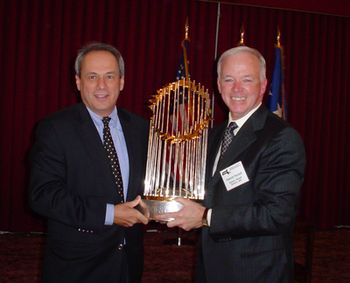
Lucchino did not come to the meeting empty handed -- he brought the World Series trophy. And, posing in the photo above with Boston Herald Publisher Patrick Purcell (right), Lucchino announced he had converted lifelong Yankees fan Purcell to the Red Sox nation.
Lucchino did not come to the meeting empty handed -- he brought the World Series trophy. And, posing in the photo above with Boston Herald Publisher Patrick Purcell (right), Lucchino announced he had converted lifelong Yankees fan Purcell to the Red Sox nation.
Monday, November 29, 2004
Journalists' group launches open-government site
The new Web site of The Coalition of Journalists for Open Government is intended to serve as a resource for journalists seeking to keep current on open-government developments or to learn more about access issues at the federal level. CJOG is a year-old alliance of more than 30 journalism organizations concerned about growing government secrecy.
Eagle Tribune calls for toughening open meeting laws in Mass.
As the Massachusetts Newspaper Publishers Association -- of which I am executive director -- prepares to file legislation this week that would toughen enforcement of open meeting laws in the state, William B. Ketter, editor-in-chief of Eagle-Tribune newspapers, publishes an editorial backing the bill. An excerpt:
"Massachusetts, the state that gave birth to American democracy, should be embarrassed. The shot heard around the world at Lexington and Concord in 1775 has become a hollow shell of silence in the very place that fired it.
"State lawmakers and Gov. Mitt Romney can change that in next year's legislative session. The publishers association has drafted bills to impose mandatory fines on officials who violate open-meeting and public- record laws and refuse to comply unless ordered to do so by a court.
"We implore the Legislature and the governor to get behind this renewed effort to strengthen the state and local open-meeting and record laws. The people of Massachusetts have the most at stake."
MBTA's rejection of ads violated free speech, court rules
The Massachusetts Bay Transportation Authority's rejection of ads promoting marijuana reform violated the First Amendment, the 1st U.S. Circuit Court of Appeals ruled today. Rejection of the ads -- submitted by Change the Climate Inc. -- constituted viewpoint discrimination, the court said. "The bedrock principle of viewpoint neutrality demands that the state not suppress speech where the real rationale for the restriction is disagreement with the underlying ideology or perspective that the speech expresses," the court explained. In the same decision, the circuit court ruled that the MBTA did not violate the First Amendment in rejecting ads from a religious group.
Friday, November 26, 2004
Prosecutor drops harassment charge against reporter
Citing a lack of evidence, Durham, N.C., District Attorney Jim Hardin has dismissed a harassment charge against a newspaper reporter who was trying to interview a woman for a story, the News & Observer reports. Hardin said in a news release that the charge against reporter Demorris Lee had "significant implications" regarding "the First Amendment issues of freedom of speech and freedom of the press." He called for Durham's judicial leaders to begin requiring that police investigate allegations brought against the media before charges are filed. [via Romanesko]
Press freedom under siege worldwide
Journalists are being murdered and their publications attacked at an alarming rate, says the Paris-based World Association of Newspapers in its half-year review of press freedom worldwide.
"Thirty-five journalists have been killed in the past six months and 63 so far this year, an increase from 53 for the whole of 2003. The war in Iraq, where seven journalists were killed in the second half of 2004 and 23 in the full year, was a major reason the death toll in 2004 surpassed that of 2003. But Iraq was not alone: eight journalists have been murdered in the Philippines in the past six months, making it even deadlier for journalists than Iraq."
Wednesday, November 24, 2004
Declassified docs detail Ford's FOIA veto battle
President Gerald R. Ford wanted to sign the Freedom of Information Act strengthening amendments passed by Congress 30 years ago, but concern about leaks (shared by his chief of staff Donald Rumsfeld and deputy Richard Cheney) and legal arguments that the bill was unconstitutional (marshaled by government lawyer Antonin Scalia, among others) persuaded Ford to veto the bill, according to declassified documents posted today by the National Security Archive to mark the 30th anniversary of the veto override. On Nov. 20, 1974, the House voted to override Ford's veto by a margin of 371 to 31; on Nov. 21, the Senate followed suit by a 65 to 27 vote, amending the FOIA to provide core protections including judicial review of executive secrecy claims.
Tuesday, November 23, 2004
Hawaii officials unaware of public's right to know
Many government officials are unaware of Hawai'i's Sunshine Law, says a report in Ka Leo O Hawai'i, a publication of the University of Hawaii.
Private community adopts FOI law
Bella Vista, a private community in northern Arkansas, has adopted the Arkansas Freedom of Information Act, the Hot Springs Village Voice reports.
"According to Linda Caldwell, general manager and editor of the Weekly Vista in Bella Vista, the property owners were responsible for the adoption of the act. 'There was great pressure from the property owners,' Caldwell said. 'There have been some requests for information, specifically salary levels. In the past they POA gave salary ranges, but nothing specific.'"
Illinois press group seeks to keep records open
The Illinois Press Association will ask Gov. Blagojevich to block newly passed legislation that would allow people with certain non-violent drug and prostitution convictions to cleanse their records so they can more easily find jobs, the Chicago Sun Times reports. Backers of the legislation contend it would ease the transition into the workplace for thousands of ex-inmates with non- violent criminal records. But the press association says criminal convictions should remain accessible for anyone to see.
Monday, November 22, 2004
Of Nazis, Novaks and the First Amendment
Sometimes First Amendment rights can be difficult to defend, says Martin Fishgold, president of the International Labor Communications Association. "It is difficult to defend the First Amendment rights in the Valerie Plame case of syndicated columnist Robert Novak and New York Times Reporter Judith Miller, both of whom have been used over and over again by the Bush Administration to sell unpopular policies, against all ethical journalistic practices," Fishgold writes.
Nevertheless, he says, defending First Amendment rights must be an absolute. "If you open the door for interpretation, you open the door for abuse of the privilege. From my point of view, one must allow the Nazis and the Novaks to slip in under the coverage if one wants to defend First Amendment rights."
Nevertheless, he says, defending First Amendment rights must be an absolute. "If you open the door for interpretation, you open the door for abuse of the privilege. From my point of view, one must allow the Nazis and the Novaks to slip in under the coverage if one wants to defend First Amendment rights."
Federal shield law unlikely, says LA Times columnist
Reporters in the United States are under siege, says Los Angeles Times media columnist David Shaw. But while some are calling for Congress to enact a federal shield law, "a Republican-dominated Congress seems unlikely to do that," Shaw says, "especially at a time when public hostility toward the media makes it unlikely that the media will be able to rally much support for such legislation."
Sunday, November 21, 2004
Sen. Dodd introduces federal shield law
Sen. Christopher Dodd (D-Conn.) Friday introduced a federal shield law that would provide an "absolute protection" for reporters' confidential sources. The "Free Speech Protection Act of 2004" protects against compelled disclosure for sources, regardless of whether the source was promised confidentiality, Dodd said.
An editorial in today's Springfield Republican endorsed the measure:
An editorial in today's Springfield Republican endorsed the measure:
"The notion of protecting the press is neither liberal nor conservative, neither Democratic nor Republican. Through a functioning free press, the public is provided a window onto the workings of the government - at all levels. To impede the work of the free press is to block the flow of information to the people."
Friday, November 19, 2004
Assault on freedom of the press
That is what Lou Dobbs called it last night, as he discussed the contempt convictions of Rhode Island television reporter Jim Taricani and New York Times reporter Judith Miller last night with Miller, First Amendment lawyer Floyd Abrams and U.S. News & World Report Editor Mort Zuckerman.
Sen. Dodd expected to introduce federal shield law
Sen. Christopher Dodd (D-Conn.) is expected to introduce a bill in Congress soon calling for a federal shield law, Editor & Publisher's Joe Strupp reports. Currently, 31 states and the District of Columbia have shield laws, which protect reporters from revealing confidential sources.
"I'm told that something is going to be introduced by Sen. Dodd this week," said George Freeman, an attorney for The New York Times, who has been overseeing that paper's response to several subpoenas, including those seeking phone records and source information from reporter Judith Miller. "I understand [Dodd's bill] is quite good from a substantive point of view -- absolute protection for confidential sources."
Thursday, November 18, 2004
Reporter guilty of contempt for refusing to reveal source
In Providence, R.I., today, U.S. District Chief Judge Ernest C. Torres found investigative reporter Jim Taricani in criminal contempt for refusing to reveal the source of an undercover videotape that aired on his television station, the Providence Journal reports. The judge scheduled sentencing for Dec. 9. Taricani faces up to six months in prison.
Wednesday, November 17, 2004
Former vonBulow prosecutor pursues reporter's source
On the eve of TV reporter Jim Taricani's contempt trial for refusing to say who gave him a copy of a secret FBI videotape, the Providence Journal profiles Marc Desisto, the special prosecutor assigned to identify the source of the leaked tape.
ProJo wins legal fees in public records suit
A Rhode Island Superior Court judge ordered the Town of North Kingstown to repay The Providence Journal the cost of attorney fees the newspaper spent on a lawsuit to obtain public information withheld by the town Police Department, the newspaper reports. But the judge denied the newspaper's request that the town pay a $1,000 fine, saying there was no evidence presented that town officials willfully violated the state's Access to Public Records Act.
NBC News president calls for federal shield law
Writing in the Wall Street Journal, NBC News President Neal Shapiro calls on Congress to enact a federal reporter shield law.
Unfortunately, there is no federal statute that supports the rights of journalists to protect confidential sources. The law provides confidentiality for psychotherapists, lawyers and doctors. It is high time journalists were added to the list. If sources can't be assured of confidentiality, they will be reluctant to come forward to the press. And if they don't confide in the press, wrongdoing could remain undisclosed. The majority of states have reporter shield laws on the books. We need the same on the federal level.
Tuesday, November 16, 2004
New Jersey plan to seal data runs afoul of health groups
A plan to shield New Jersey government records from the eyes of terrorists is drawing objections from environmental and public health advocates, who say it also would keep workers and residents in the dark about potential exposure to hazardous materials, the Star-Ledger reports. The proposed regulations, designed to clarify anti-terror limits on the state's Open Public Records Act, prohibit agencies from releasing any plans that detail a building's inner workings.
They also make secret all records of airports, mass transit facilities, bridges, tunnels, public utilities, emergency-response facilities, arenas, stadiums, state-owned buildings and storage sites for hazardous materials, the report says. Also confidential would be records showing where explosives or pharmaceuticals are stored, how nuclear power plants operate, how emergency-response teams are deployed, or that disclose the outbreak of contagious diseases among animals.
To gain access to any of these records, the report says, a member of the public would need permission from the attorney general's Domestic Security Preparedness Task Force and the head of a Cabinet-level state agency. The agency head would be free to release a record only if there were a "bona fide need for public access."
Monday, November 15, 2004
Gonzales' record on press freedoms and right to know
The Reporters Committee for Freedom of the Press today released Gonzales, Press Freedoms and the Public's Right to Know, its evaluation of the likely impact of Attorney General Nominee Alberto Gonzales on press freedoms and the public's right to know. RCFP researched Gonzales' performance as a judge on the Texas Supreme Court from January 1999 to December 2000 and as White House counsel since January 2001. It concluded that Gonzales' role as White House counsel reveals a penchant for strictly regulating access to government and executive-branch information, while his term on the Texas high court indicates a recognition of the First Amendment interests in newsgathering and reporting.
Sunday, November 14, 2004
Boston Law Librarians program on blogs
On Wednesday, I will be speaking about blogs to the Association of Boston Law Librarians.
Friday, November 12, 2004
California voters add Sunshine to state constitution
California voters added a sunshine amendment to the state constitution Nov. 2, the Reporters Committee for Freedom of the Press reports. "Eighty-three percent of California voters endorsed Proposition 59, adding a right-to-know provision to the state constitution. California joins Florida, Louisiana, Montana, and New Hampshire in having freedom of information provisions in their constitutions," the report said.
Columnist: Our not-so-free press
We read of China and Zimbabwe throwing journalists in jail, but similar abuses are unfolding in the United States, writes New York Times columnist Nicholas D. Kristof.
"The first reporter likely to go to jail is Jim Taricani, a television reporter for the NBC station in Providence, R.I. Mr. Taricani obtained and broadcast, completely legally, a videotape of a city official as he accepted an envelope full of cash.
"U.S. District Judge Ernest Torres found Mr. Taricani in contempt for refusing to identify the person he got the videotape from, and the judge fined him $1,000 a day. That hasn't broken Mr. Taricani, so Judge Torres has set a hearing for Nov. 18 to decide whether to squeeze him further by throwing him in jail."
Norwood officials violate open meeting law, DA rules
Officials in Norwood, Mass., who are working to bring a YMCA to town were found to have violated the state open meeting law when they met with Y representatives behind closed doors, the Daily News Transcript reports. The Norfolk County district attorney's office ruled that the team of town officials conducting negotiations on the Y broke the law by holding the session with the YMCA to consider deals related to a long-term lease of town-owned property.
What makes newspapers good?
Former New York Times managing editor Gerald Boyd says it well:
"Good newspapers are unwavering in their commitment to their community, whether that 'community' is a national audience, a big city or a small town. They serve as a kind of glue that provides various factions with the same information so that they can unite or divide based on their views.
"They are linchpins for change, not for their own personal gain or to buck the status quo. Instead, they understand their mission: to use all of their collective talent to make the community a better place. "
Tuesday, November 02, 2004
SJC hears arguments today in Cape paper's suit against sheriff
The Massachusetts Supreme Judicial Court hears arguments today on whether the Barnstable County Sheriff's Office on Cape Cod is required under public records law to release the identities of more than 200 reserve deputy sheriffs appointed by Sheriff James Cummings since 1999, the Cape Cod Times reports.
The reserve deputies, as members of the nonprofit, charitable Barnstable County Deputy Sheriff's Association, have a right to privacy, the sheriff argues. They have no law enforcement training or power, the sheriff contends, performing fund-raising and charitable work on behalf of the sheriff for senior citizen and youth groups.
The Cape Cod Times filed the lawsuit last year when Cummings declined to release the names. It maintains the sheriff also has the ability to call the reserve deputies to active duty. It says the public has a right to know who was appointed by the sheriff and allowed to carry badges as reserve deputies.
According to the report in the Cape Cod Times, The Boston Herald recently filed a similar lawsuit seeking the names of reserve deputies in Middlesex County.
Subscribe to:
Posts (Atom)